Showing posts with label 412. Show all posts

Wednesday, April 22, 2020

Calculating your soap mold

Hi There! Today I am going to give you 3 ways to figure out the size of your soap mold today. 

Method #1: Sometimes when I need to know the size recipe I can fit into a mold I cheat and look it up on the site I purchased it from. But for those times that I either can't remember where I got a mold from, if it's been discontinued or even if it is a homemade mold like a milk carton or pringles can for instance there is a calculation for figuring this out. AND it's quite simple :)

Method #2: The below formulas will give an answer in ounces but this can easily be converted to grams if that it your preferred working unit.

For square and rectangular molds: 


Length x Width x Height = X
X x 0.4 = Oz of oils needed (this number can be used in the soap calculator.)


If using centimeters your multiple is 0.7 instead of 0.4

If you need this in pounds take the ounces needed and divide by 16.
Example: 12” x 4” x 3” = 144”
144” x 0.4 = 57.6 oz always round down to prevent over-pouring so 57 oz of oil will fit into this mold.

In pounds this would be 57.6 oz / 16 oz = 3.6 pounds

For cylinder molds:
3.14 x radius squared x height of pour = X

Radius is the distance from the center of the circle to the edge. The  diameter is the distance across the entire circle. So a 3" round PVC pipe has a radius if 1.5"


X x 0.4 = Ounces of oils needed
Example: To figure out for a 3" round by 12" height of a cylinder mold:


3.14 x 1.5" x 1.5" x 12" = 84.78"
84.78" x 0.4= 33.91 ounces of oils (round down to 33 oz).

Method #3: As a third option if you are unsure of your math skills or just to confirm that you did your math correctly you can also place your mold on your scale and tare to "0" then fill with water to the height you want your soap to be. Soap is more dense than water so your batch may be a little shorter than you anticipate but it will get you pretty close without going over. This method will get you the full size of your batch, water, oils and lye.

I hope these tips and tricks help you in your soap making and calculating endeavors. Please feel free to ask questions!

As always,
Your Soapsmith


Wednesday, March 18, 2020

Oat Milk Soap (palm free!)

This is part 2 of the great oat caper! I've always wanted to partake in a caper, this may be the closest I get so let's just roll with it. To read about part one in which I made home made oat milk for this project click here

Recently I formulated twelve, yes, TWELVE new recipes and will be working through them all and writing (and possibly making videos) of the adventures. I am also going to be working with additives that I typically do not work with, it's a sort of learning and growing experiment that I am taking you all on. Today we will be using a palm free recipe that also contains shea butter. When I make test batches I make them at 1-lb each, large enough to have 4 nice sized bars to test out but not so large that I am wasting ingredients if a batch doesn't work out.

Let's look at our oil profile:
I choose olive, grapeseed, coconut, shea butter and castor oils. 

Olive oil has a pH of 5.5 which is the same as the sebum on our skin so it's quite complementary and found in many soaps and skin care products. It is medium in weight, mild and conditioning. It does not make great bubbles and can make a soap feel slimy in high amounts.  It can also slow down trace and take longer to cure in high amounts. It can product a surprisingly hard bar of soap for being a liquid oil. This is the oil used to make a true castile soap.

Grapeseed oil offers medium lather and mild cleansing. I have read accounts that this oil is prone to a short shelf life and may cause early rancidity and possibly DOS in your finished product. I have read other accounts that it has a normal shelf life too so I am still forming an opinion on this myself. Personally I have not had grapeseed oil become rancid or ruin any products so I decided to use it in this recipe. It's always a good idea to ensure you are purchasing your oils from a reputable source. If you are purchasing from a grocery store make sure it's a store that is busy enough to be able to turn over their products at a regular rate, this will help to ensure as fresh an oil as possible.

Coconut oil- creates a hard bubbly bar of soap. In high amounts (above 30%) it can create a drying bar of soap. To accomodate for a high % of coconut oil you would need to increase your superfat. For today though we are using a lower amount so it should not be an issue.

Shea butter- is mild and produces a creamy stable lather, it will also contribute to a long lasting bar of soap.

Castor oil- this is a special oil that has earned an interesting story in history, click here to read about how it was used as a form of punishment. It is the only oil to contribute ricinoleic fatty acid. It acts as a humectant and contributes to bubbles in soap.

I typically also add sodium lactate to my batches but for this project I am going to skip it so I can see how this recipe acts without it. I am curious to see if a palm free recipe will be as hard as I typically like.

Remember the oat "bits" from yesterdays milk making session? Well I saved them and added some at 1Tbsp PPO. So essentially since this was a 1 pound batch I added 1 tablespoon at light trace.

Below is the recipe listed by percentage. Please run through a soap calculator to get the size you need based on your chosen mold. I like this calculator if you need a recommendation:

Super Fat: 5%
Water Content (oat milk in this instance): 35%

Fragrance oil: 0.5 oz PPO

45% Olive oil
12% Grapeseed oil
20% Coconut oil
17% Shea butter
6% Castor oil

Notes: Since we are using a thick liquid that has solids which will account for part of its weight I chose to keep the water content on the high side. I also wanted to know if any of that mild, sweet oat scent will come through so I am doing my fragrance at half the amount I typically would do. Also, I am using oatmeal, milk and honey fragrance from Brambleberry, it's such a nice soft and sweet scent, very pleasant and plays very well in soap. You can find that fragrance here if you are interested.


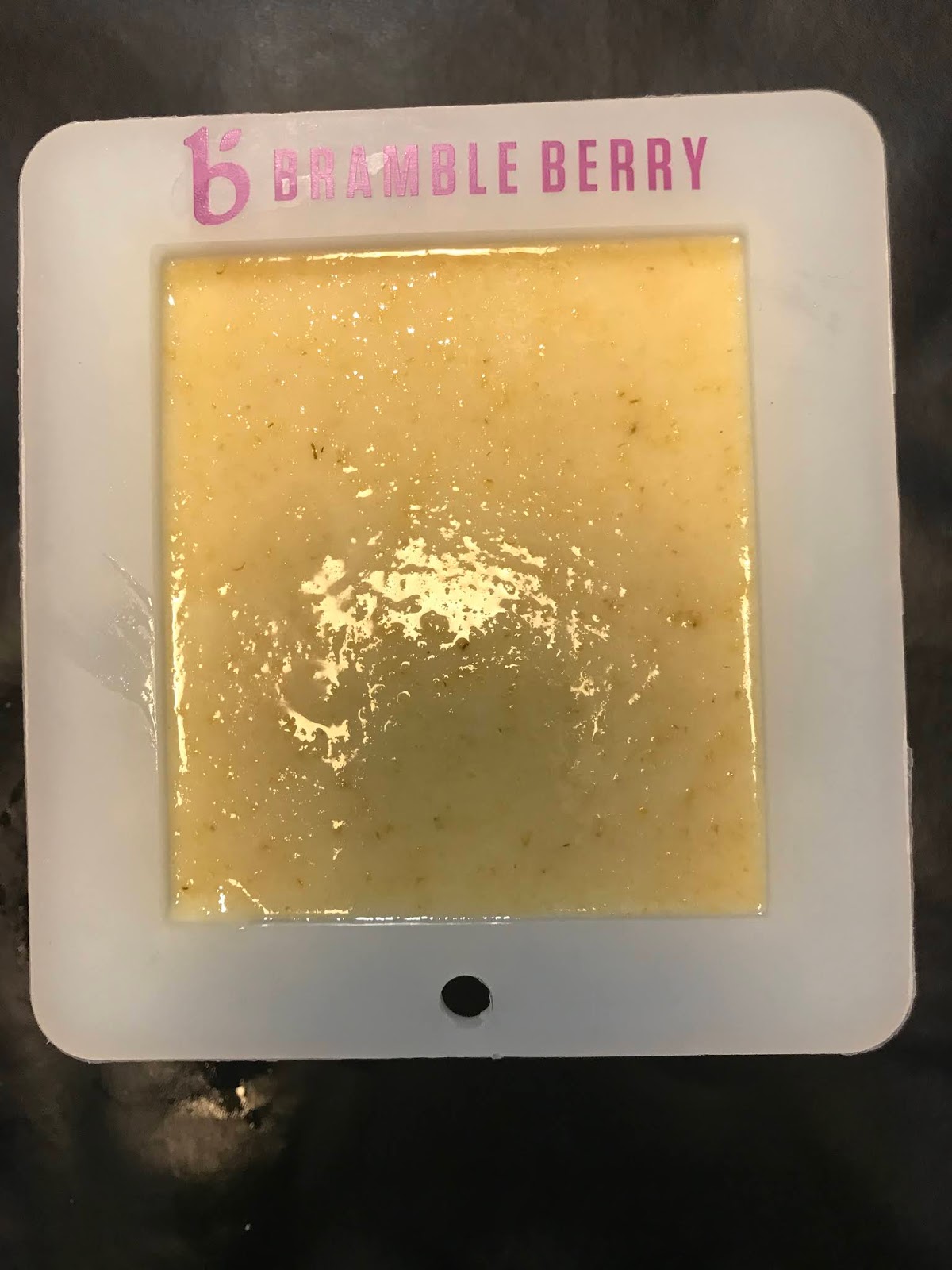
Oatmilk soap in test mold.


Post soaping notes: So I made the soap and unmolded, cut and cured it and am now coming back to add my batch notes. Overall I am very happy with the hardness this palm free recipe was able to provide and will definitely make it again. This soap performs great too, it is bubbly and long lasting, smells great and has some light exfoliating due to the oat bits I added.
Some things I will do differently are to cut the amount of oat milk to about 50% and dissolve my lye in 50% distilled water before adding the oatmilk. Another way to handle this is to increase the water amount using to make the oatmilk. They reason I just cut the amount and also use water is because I like to SEE that my NaOH is completely dissolved and with an opaque liquid I can't tell. It's a matter of preference really. I might also add the oat milk to my oils instead of the lye water so the lye water will not burn off the sugars. There are a couple of different options on how to work with this recipe. I was otherwise very pleased with the recipe and really happy that I did the fragrance at half the normal rate too, it was just such a soft, sweet and subtle hint. Perfect for this batch.  

If you try this recipe or do a version of it let me know, I'd love to hear how it went and what changes you tried to make it your own.

Happy Soaping until next time.
~Your Soapsmith


Wednesday, March 11, 2020

Making oat milk in preparation to make an oat milk soap

Howdy Soapsmith Nation! I am working on some new recipes with additives I have been wanting to try out. After 10 years of making my tried and true recipes I have decided it's time to, once again, spread my wings and make some new awesome recipes! 

I wanted to work with oatmeal for a recipe so I decided to make it into oat milk first. Let's take a step back and look at the skin care benefits that oats can impart for us.

There are properties that will carry through saponification and some that will not carry through but are present in other skin care formulations, let's talk about both!

  • Inexpensive and readily available
  • Typically low allergenic and good for all skin types including problem skin
  • Can provide some exfoliation
  • Contains anti-oxidants and are anti-inflammatory
  • May treat dry skin and remove dead skin cells
  • Contains a compound called saponins which are natural and mild cleansers
Some talking points that may not carry over into soap but are relevant to other skin care formulations are:


  • Helps to keep skin hydrated by forming an occlusive layer on the surface that retains water in the skin
  • Imparts moisturizing, soothing, conditioning, and nourishing qualities, significantly improving skin dryness and roughness
  • Helps reduce skin inflammation making it ideal for treating inflammatory skin conditions
I would be more interested in adding colloidal oatmeal to a lotion or butter to see if I could get these results. As an aside this would make a wonderful set, a lotion and soap both with various forms of oatmeal in it.

I also looked into what oatmilk/oatmeal might do for a soap formulation and what I found is not that much so I changed gears and looked up some nutritional value in hopes to find properties that may come through in a soap.

1. sugar content - 1.1g per 1 cup - might contribute to more bubbles (may also not be enough to make a difference.)
2. gluten content - this is tricky, technically oats ARE gluten free but if they are not processed in a gluten free facility they shouldn't be marketed as such. I am starting to see more people asking and searching for gluten free soaps so this is a good point to remember.
3. protein content- 6g per 1 cup (probably irrelevant to soap...)
4. fat content - 3.2g per 1 cup- maybe slightly relevant as it could contribute to superfat but probably not in a significant way.
5. sodium content 115mg per 1 cup, we do know that salt can contribute to a harder bar of soap so this might also be helpful, but again based on how small of an amount it is it's probably not significant.
There are also vitamins A, B, C, Iron and Magnesium listed, there properties will most likely not survive saponification though.


Alright so now we know what oats can bring to this party, let's make oat milk!

I combed through the internet and saw many variations on how to do this. Many of them had similarities so it makes it kind of easy to give this a go. In the end I decided to use a loose version of what it on the actual oatmeal container and see how that worked out. 


As a side note pretty much all recipes recommended using old fashioned oats as opposed to steel cut or instant and all recommended blending immediately instead of letting soak because it makes for a slimy mixture (this is probably more relevant to the folks that want to use it in coffee).

Here is what I did:
2C oats 
4C water (recommendation to use distilled for soap making). 

Instructions:
1. Add water to oats, mix with spatula then hand blend for about 30 seconds. Let sit for roughly 30 minutes to thicken.

After 30 minutes it was a thin porridge consistency and I was happy with the size of the oat pieces. 

BUT

I stepped away for approximately an hour to handle something and then it became more like a thick porridge which I did not want. This may have worked to my advantage because I determined that I wanted oat milk and not oat porridge for this project. So I went ahead and strained the milk with a wire strainer and it became a nice, thick milk with some pieces which will be great as an exfoliant.

I managed to pull off about 1C of oat pieces (grains? I don't know
what to call them now). Which left me with about 1C still in my oat milk. For me this is very doable.

I weighed out and froze the portion of oat milk I will need for the upcoming soap recipe. I also set aside the extra oat....pieces as I can add them back in to my recipe as an additive. 

Ok so stay tuned for part 2 of this little adventure when I reveal my recipe and we make a super sweet batch of oat milk soap!

~Ta for now
'Soapie

References:
https://www.schoolofnaturalskincare.com/11-benefits-of-oatmeal-for-your-skin/


Wednesday, February 26, 2020

The first E-Book is finished!


Well I finally did it! I wrote a soap making book. I have been wanting to start writing books related to bath and body product making for awhile and I am really pleased with the final result. I went through and detailed out all the big important parts that every beginner should know such as safety, equipment, supplies and provided a couple of basic recipes that can easily be made using oils and fats found at a local grocery store. I also included other information that I wish I had known as a beginner (you don't NEED to have every single supply offered by soap making supply vendors to succeed, for instance!) 


There is also some neat bonus information that go into a little bit of detail about additives including color, fragrance, special liquids to use like milks and beer and then an extensive troubleshooting section as well as references and resources (and a first timers shopping list too!)

This project was a labor of love and really sparked a creative part of my mind that I completely enjoyed. I plan to write and publish many more in the coming years because it gives me great joy to watch and encourage other novice makers to succeed in what I find to be a fascinating industry. 

To purchase this book please check out our site: https://www.soapsmithspgh.com/collections/e-books/products/beginner-soapmaking-guide-e-book

It's truly been a pleasure to research and write both this blog and this first e-book, I look forward to being able to share more in the future.

~Your Soapsmith


Monday, December 30, 2019

A look back on 2019

It's been a busy year here at the studio both personally and professionally. I just re-read my 2019 goals blog and am feeling like I actually was able to accomplish what I set out to do. For the company one of my main goals is always to be as environmentally friendly as possible. I spent countless hours researching packaging options and making decisions regarding which would be the most friendly both for the environment while staying budget friendly. As a small company we sometimes have less options because we are simply not able to purchase in the quantities that large companies are able to. Also some packaging that I REALLY wanted to use required specialized equipment which made it not feasible for us. I also tried some new ideas over the summer at the markets such as a bulk filling option for lotions and scrubs AND I left all my soaps unwrapped and sold them by weight instead of by one flat price. It was a neat concept and I was excited to see how many people supported the idea but since people come to markets not expecting to purchase in bulk I ultimately was still providing the containers for filling. I DO think that people are open to this concept and would embrace it in a store if given the option. I also think that by participating in these markets I helped people to know about us as local makers which I think is also an environmentally friendly move.

So what did I end up doing about packaging? Well I offered 2 options for containers at the markets a 4oz glass jar or a 2oz PCR (post consumer recycled) plastic container. It's not virgin plastic so I felt better about using it but it's also not a perfect solution in my mind. The problem with glass is that my products sometimes end up in a shower or being held by wet hands and the glass just simply is unsafe at that point. For those reasons I do not find glass to be a great solution for bath and body products. 

As for other packaging options I looked into I love the idea of compostable packaging but as far as those container options go I really could not find any that would hold up to products like scrubs and lotions, the containers would have broken down before the product was able to be used and also the container would not have held up in wet environments making it possible for mold, yeast and bacteria to grow thereby negatively impacting the product. I did have an idea to use mini milk cartons for refills for people but those actually require special machines to fill and close the container, also the minimum buy was insanely high, it was not a feasible solution unfortunately. I did go back to shrink wrapping my soaps for now. The system I use is called Biolefin and it is a biodegradable plastic that begins to breakdown within 18 months of being used and finishes its cycle within 3-5 years. I like this because unlike compostable materials it will breakdown regardless of where it is disposed (trash, recycle bin, compost etc.) whereas some compostable materials will not break down unless properly disposed. So if the consumer is not aware or does not have access to a composting system then the compostable material simply becomes another piece of trash in a landfill. 

Packaging is complicated is really what I learned this year, there is no simple one-size-fits-all answer. As new technology comes out and as the zero waste movement pushes large manufacturers to think through these issues more critically though I think that small companies will also have more green options available to them, I will never stop looking into what the next best solution might be.


Shampoo Bar
One great product that came of all this zero waste interest was it pushed me to develop a shampoo bar. I spent the year learning about hair and proper surfactants to use on it and then got to formulating. I wanted a product that was long lasting, gentle and vegetarian. I actually formulated three different bars and had a very strong front runner from the get go. These babies have been selling like hotcakes and I couldn't be happier. For me a shampoo bar can last 3-4 months or more if my hair is fairly short. For others that have purchased them they agree with this. This replaces the plastic shampoo bottles which is a huge win! I currently have a conditioner bar in the works and hope to release it in 2020, the conditioner bars seem to last much longer thus far. 

As for personal goals we have been doing really well on our zero waste journey. I did not need to buy any plastic storage bags this year because we were able to stay in the groove of using the silicone storage pouches as well as our normal food storage containers. We also tried misfit market and really liked it, I stopped it for the summer because we support a local CSA farm share and did not need both but we will go back to misfit market now that that has stopped. It provided great variety and none of the items we got were unusable which was great! We did lots of little things which are green such as upgrade the lighting in our house to include more LED options and also have sensors on our outdoor lighting so it only comes on when needed. In my opinion every little thing counts when trying to do better.

So how was your 2019? What goals did you set and were you able to hit the mark? What will be your goals for 2020?

'Till next year (next decade!) my friends, 
~Your Soapsmiths


Tuesday, October 15, 2019

Reading and understanding Safety Data Sheets, aka SDS (formerly known as MSDS)

I had to learn about Safety Data Sheets (SDS) many different times throughout my schooling and then later in life in my professional career as well. It occured to me that maybe not everyone is familiar with them and I find them immensely helpful to refer to from time to time so I wanted to share what they are used for and why they may be helpful to you someday.

Safety Data Sheets were formerly known as Material Safety Data Sheets or MSDS, this terminology change was announced in 2013 and enforced in the end of 2015 to mid 2016 with the goal of making them more consistent and easier to understand across the board. They now adhere to something called the Globally Harmonized System of Classification and Labeling of Chemicals (GHS). There are even pictograms associated with this new system which is helpful for a quick reference.

There are 16 distinct sections to an SDS sheet:
1. Identification
2. Hazard(s) Identification
3. Composition/Information on Ingredients
4. First Aid Measures
5. Fire Fighting Measures
6. Accidental Release Measures
7. Handling & Storage
8. Exposure Controls / Personal Protection
9. Physical & Chemical Properties
10. Stability and Reactivity
11. Toxicology Information
12. Ecological Information
13. Disposal Considerations
14. Transport Information
15. Regulatory Information
16. Other Information

The first 8 sections are set up for quick reference for the people transporting and handling the chemicals as well as any emergency responders should there be an issue.
Sections 9-11 handles technical and scientific data. Sections 12-15 are not actually mandatory but they are required to be GHS compliant and section 16 will contain information on the SDS itself such as revision dates and changes since last version.

Employers are responsible for making sure there is an SDS sheet for every chemical on site and they must be available for employee reference in their immediate work area. These would most likely be for any cleaning agents in the workplace however essentially ANY product or raw material (i.e. base ingredients) can have an SDS sheet. 

Even "natural" products such as Dr. Bronner's Soap has SDS sheets as well as base ingredients such as Olive Oil. I am pointing this out because I have heard misinformed people many times refer to the information on an SDS sheet of a raw material while trying to make a point about the safety of the entire product. This is always going to be inaccurate because the SDS sheet is informing about the raw material in its most concentrated form and not as the material as used within a formulation in a diluted form. I have read countless times someone who pointed out that the person handling "xyz" ingredient has to wear a respirator or hazmat suit or face mask to handle the ingredient so that must mean it's not safe. WRONG! This reasoning could not be further from the truth. I wear gloves and sometimes a respirator when mixing sodium hydroxide which is a necessary part of making handmade soap but that in no way means that the soap is dangerous or unsafe simply because sodium hydroxide was used in the making process. It simply means that in its concentrated form I am aware that it could cause me harm so I protect myself. 

So there you have it, SDS sheets in a nutshell. Links are below for further reading if you wish.

Stay wise my friends, 
~Your Soapsmith

https://chemicalsafety.com/online-sds-databases/
https://www.osha.gov/Publications/OSHA3514.html
https://fscimage.fishersci.com/msds/96356.htm
https://www.drbronner.com/retailers/material-safety-data-sheets-msds/


Wednesday, June 26, 2019

Green "life hack"


This is off topic of soapmaking, selling or anything in-between but I thought it was a cool idea and wanted to share. I have been using this little eco friendly life hack for quite some time. 

For those that purchase the paper "milk" cartons that have the plastic pour spout you can save and reuse that plastic pour spout for so many other items. Check it out, below are the two components you need to make this happen. Save the pour spout from the milk carton and locate a couple of canning jar rings.


Next, cut the milk carton to for the size canning ring you want to use. Tip: I put the spout off to the side for easier pouring. Trace your circle and cut it out. 

Finally put it all together and enjoy your new green pour spout! Below are my sugar and coconut milk pictured with their spiffy pour spouts.


I will finish by saying that while these don't last forever for liquid items like the coconut milk they do last a very long time and add more miles to the single use plastic pour spout that is on the carton. They are quick and easy to make also and I like knowing that I am reusing something that would otherwise end up in a landfill because (at least where I live) these milk cartons and their parts are not recyclable.

What are some of your favorite green living hacks? I am always excited to learn new ways to re-use everyday items so feel free to share.

As always
~Your clean & green Soapsmith


Wednesday, June 19, 2019

Pop-up markets in Pittsburgh


We will be at the Garfield and Squirrel Hill night markets in Pittsburgh this summer and fall. At these markets we will be offering select items from our classic and beer soap line as well as from our new Greenline. 


The awesome little sink! YES, it works :)


To make our booth even more fun we have an awesome little sink that you can use to test products! It was a BIG HIT at the first market of the season in Garfield and we cannot wait for more people to come out and check it out. 


Reusable face scrubbies available in pink and
blue flannel with a terry cloth backing.

Additionally we are continually creating partnerships with other eco friendly makers and will have their wares available at the our booth this summer too. Our first partnership is with Paige Leigh Designs. These ladies make awesome facial scrubbies that are a soft terry cloth on one side and a wonderful flannel on the other, they fit nicely into the palm of my hand and are completely washable for many, many re-uses. We are proud to be able to offer this product to our tribe here in Pittsburgh, PA.

As we forge new relationships we will announce them and very happily make them available at the markets for all to enjoy.

See you soon!
~Your Soapsmith


Friday, June 14, 2019

NEW Partnership with Arsenal Cider

We have formed a fantastic new partnership with Arsenal Cider located in Pittsburgh, PA! 

We were sitting in their Lawrenceville shop one fine afternoon enjoying a glass of their amazing cider and I got the idea that "this cider needs to be in my soap" and so I made it.

With the wonderful fragrances of apple paired with grapefruit essential oil this soap is A-MAZING! It bubbles fantastically due to the sugar content in the cider and the scent is sweet and bright with a variety of notes which are sure to please the nose. 

This soap is currently available exclusively at their Lawrenceville location and pairs well with a growler of your favorite cider. With Father's Day coming I think that this could be a perfect gift for all those hard working dads out there, don't you?

Below is a video that my hubby made showing the process of making the soap. :)


Here's to good cider and good soaps.
~Your Soapsmith

Wednesday, June 12, 2019

Introducing the Greenline


We are excited to introduce our new "Greenline"concept. The idea is simple; we would rather invest in your skin than in our packaging. Sure fancy little boxes and wrappers look nice, but they raise your price without adding anything beneficial to the product itself. Plus, the world could do with a little less trash and we'd like to do our part. 
Luxurious salt soak
You can now buy these specially created label-free items in bulk at our Pittsburgh pop-up markets. Just bring a clean container with a lid for items like our salt soaks. We'll have containers available should you need and all of our Greenline products are available by the ounce to exactly fit your needs.
If you're local to Pittsburgh, then we invite you to stop down to our next pop-up. If you're from out-of-town, just give us the name of your favorite shop and we'll take care of the rest.

Select soaps available
We will continue to add to this line and keep everyone updated. 


Stay green my friends!

~Your Soapsmith


x

Wednesday, February 6, 2019

RAW Natural Born Artist Show

We have been plugging away over here in the studio and one fine
day while adding a fresh coat of (recycled) paint to the walls I got a call asking if I wanted to be a featured artist in an upcoming show? Well I thought, this sounds kind of neat! While I have always thought of my soaps as usable art I didn't realize that others may as well.

We checked into the organization a little bit and decided to go for it, why not?!? It is with great excitement that I announce that we will be a featured artist at the end of this month in Pittsburgh! We are both humbled and excited about being able to showcase our creations in such a cool way. 

So what is RAW? It is a show that is in cities all over the country and gives new and emerging artists a chance to be discovered. This show includes musicians, performance artists, fashion designers, photographers, jewelery and other accessories designers as well we us, the Soapsmiths!

We have been working like crazy in the studio (yes, I stopped painting immediately!) to make products, make sure our packaging is up to snuff, update product photos (they need to look art show ready you know.) and we are even working on a super artsy feeling booth for our wares. While this is a lot of work it is also really fun to be able to think of our soaps as little pieces of art.

If you are reading this and live in Pittsburgh or will be in Pittsburgh at the end of February come on out and check this event out. 

We have a sweet profile up on their page which you should take a peek at: http://rawartists.org/soapsmithspgh tickets can also be purchased through this link. 

We will continue to update on what we are up to with this neat opportunity and hope to see you there!

~Your Soapsmiths