Showing posts with label soap. Show all posts

Wednesday, April 22, 2020

Calculating your soap mold

Hi There! Today I am going to give you 3 ways to figure out the size of your soap mold today. 

Method #1: Sometimes when I need to know the size recipe I can fit into a mold I cheat and look it up on the site I purchased it from. But for those times that I either can't remember where I got a mold from, if it's been discontinued or even if it is a homemade mold like a milk carton or pringles can for instance there is a calculation for figuring this out. AND it's quite simple :)

Method #2: The below formulas will give an answer in ounces but this can easily be converted to grams if that it your preferred working unit.

For square and rectangular molds: 


Length x Width x Height = X
X x 0.4 = Oz of oils needed (this number can be used in the soap calculator.)


If using centimeters your multiple is 0.7 instead of 0.4

If you need this in pounds take the ounces needed and divide by 16.
Example: 12” x 4” x 3” = 144”
144” x 0.4 = 57.6 oz always round down to prevent over-pouring so 57 oz of oil will fit into this mold.

In pounds this would be 57.6 oz / 16 oz = 3.6 pounds

For cylinder molds:
3.14 x radius squared x height of pour = X

Radius is the distance from the center of the circle to the edge. The  diameter is the distance across the entire circle. So a 3" round PVC pipe has a radius if 1.5"


X x 0.4 = Ounces of oils needed
Example: To figure out for a 3" round by 12" height of a cylinder mold:


3.14 x 1.5" x 1.5" x 12" = 84.78"
84.78" x 0.4= 33.91 ounces of oils (round down to 33 oz).

Method #3: As a third option if you are unsure of your math skills or just to confirm that you did your math correctly you can also place your mold on your scale and tare to "0" then fill with water to the height you want your soap to be. Soap is more dense than water so your batch may be a little shorter than you anticipate but it will get you pretty close without going over. This method will get you the full size of your batch, water, oils and lye.

I hope these tips and tricks help you in your soap making and calculating endeavors. Please feel free to ask questions!

As always,
Your Soapsmith


Wednesday, March 18, 2020

Oat Milk Soap (palm free!)

This is part 2 of the great oat caper! I've always wanted to partake in a caper, this may be the closest I get so let's just roll with it. To read about part one in which I made home made oat milk for this project click here

Recently I formulated twelve, yes, TWELVE new recipes and will be working through them all and writing (and possibly making videos) of the adventures. I am also going to be working with additives that I typically do not work with, it's a sort of learning and growing experiment that I am taking you all on. Today we will be using a palm free recipe that also contains shea butter. When I make test batches I make them at 1-lb each, large enough to have 4 nice sized bars to test out but not so large that I am wasting ingredients if a batch doesn't work out.

Let's look at our oil profile:
I choose olive, grapeseed, coconut, shea butter and castor oils. 

Olive oil has a pH of 5.5 which is the same as the sebum on our skin so it's quite complementary and found in many soaps and skin care products. It is medium in weight, mild and conditioning. It does not make great bubbles and can make a soap feel slimy in high amounts.  It can also slow down trace and take longer to cure in high amounts. It can product a surprisingly hard bar of soap for being a liquid oil. This is the oil used to make a true castile soap.

Grapeseed oil offers medium lather and mild cleansing. I have read accounts that this oil is prone to a short shelf life and may cause early rancidity and possibly DOS in your finished product. I have read other accounts that it has a normal shelf life too so I am still forming an opinion on this myself. Personally I have not had grapeseed oil become rancid or ruin any products so I decided to use it in this recipe. It's always a good idea to ensure you are purchasing your oils from a reputable source. If you are purchasing from a grocery store make sure it's a store that is busy enough to be able to turn over their products at a regular rate, this will help to ensure as fresh an oil as possible.

Coconut oil- creates a hard bubbly bar of soap. In high amounts (above 30%) it can create a drying bar of soap. To accomodate for a high % of coconut oil you would need to increase your superfat. For today though we are using a lower amount so it should not be an issue.

Shea butter- is mild and produces a creamy stable lather, it will also contribute to a long lasting bar of soap.

Castor oil- this is a special oil that has earned an interesting story in history, click here to read about how it was used as a form of punishment. It is the only oil to contribute ricinoleic fatty acid. It acts as a humectant and contributes to bubbles in soap.

I typically also add sodium lactate to my batches but for this project I am going to skip it so I can see how this recipe acts without it. I am curious to see if a palm free recipe will be as hard as I typically like.

Remember the oat "bits" from yesterdays milk making session? Well I saved them and added some at 1Tbsp PPO. So essentially since this was a 1 pound batch I added 1 tablespoon at light trace.

Below is the recipe listed by percentage. Please run through a soap calculator to get the size you need based on your chosen mold. I like this calculator if you need a recommendation:

Super Fat: 5%
Water Content (oat milk in this instance): 35%

Fragrance oil: 0.5 oz PPO

45% Olive oil
12% Grapeseed oil
20% Coconut oil
17% Shea butter
6% Castor oil

Notes: Since we are using a thick liquid that has solids which will account for part of its weight I chose to keep the water content on the high side. I also wanted to know if any of that mild, sweet oat scent will come through so I am doing my fragrance at half the amount I typically would do. Also, I am using oatmeal, milk and honey fragrance from Brambleberry, it's such a nice soft and sweet scent, very pleasant and plays very well in soap. You can find that fragrance here if you are interested.


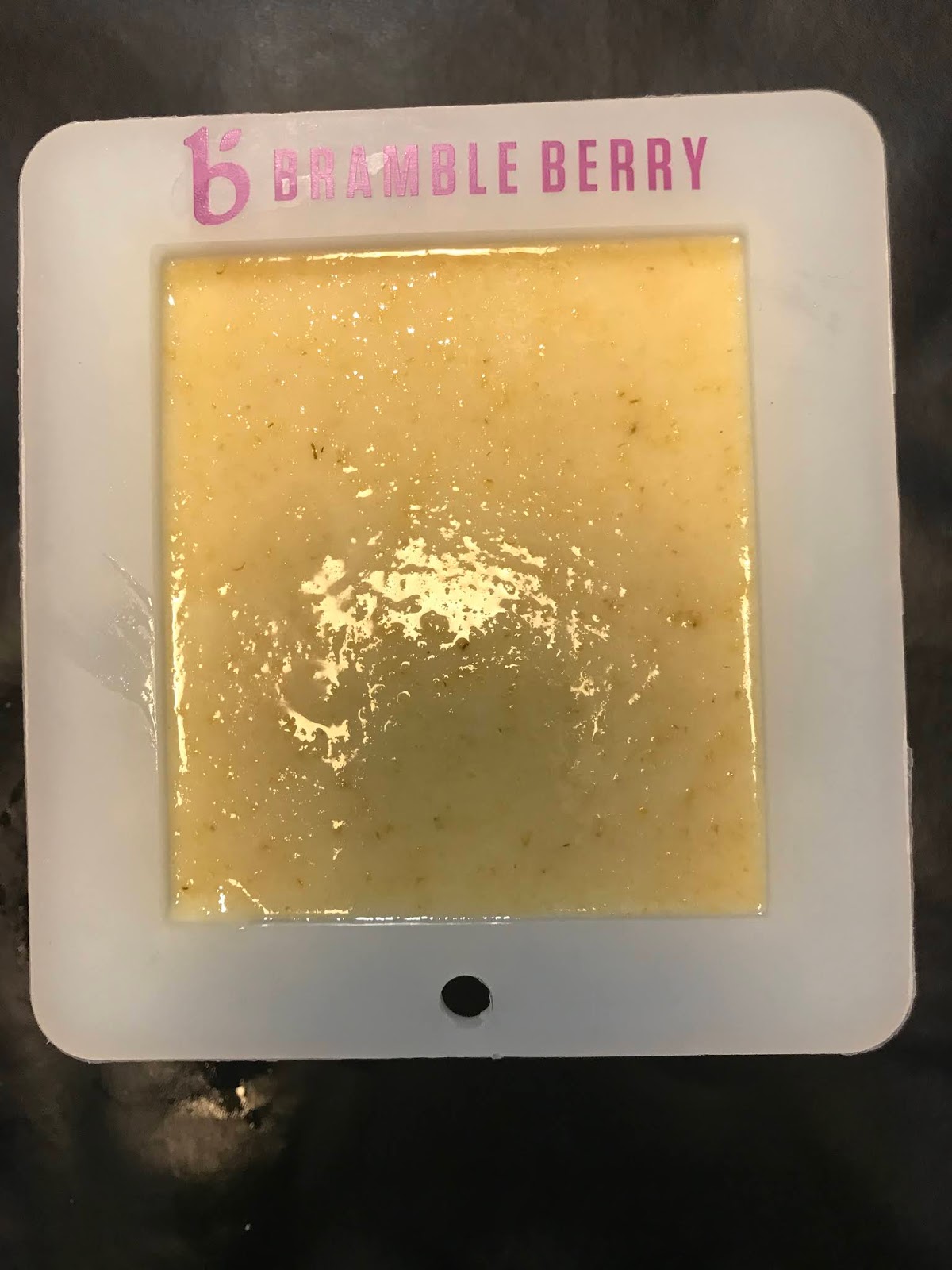
Oatmilk soap in test mold.


Post soaping notes: So I made the soap and unmolded, cut and cured it and am now coming back to add my batch notes. Overall I am very happy with the hardness this palm free recipe was able to provide and will definitely make it again. This soap performs great too, it is bubbly and long lasting, smells great and has some light exfoliating due to the oat bits I added.
Some things I will do differently are to cut the amount of oat milk to about 50% and dissolve my lye in 50% distilled water before adding the oatmilk. Another way to handle this is to increase the water amount using to make the oatmilk. They reason I just cut the amount and also use water is because I like to SEE that my NaOH is completely dissolved and with an opaque liquid I can't tell. It's a matter of preference really. I might also add the oat milk to my oils instead of the lye water so the lye water will not burn off the sugars. There are a couple of different options on how to work with this recipe. I was otherwise very pleased with the recipe and really happy that I did the fragrance at half the normal rate too, it was just such a soft, sweet and subtle hint. Perfect for this batch.  

If you try this recipe or do a version of it let me know, I'd love to hear how it went and what changes you tried to make it your own.

Happy Soaping until next time.
~Your Soapsmith


Wednesday, March 11, 2020

Making oat milk in preparation to make an oat milk soap

Howdy Soapsmith Nation! I am working on some new recipes with additives I have been wanting to try out. After 10 years of making my tried and true recipes I have decided it's time to, once again, spread my wings and make some new awesome recipes! 

I wanted to work with oatmeal for a recipe so I decided to make it into oat milk first. Let's take a step back and look at the skin care benefits that oats can impart for us.

There are properties that will carry through saponification and some that will not carry through but are present in other skin care formulations, let's talk about both!

  • Inexpensive and readily available
  • Typically low allergenic and good for all skin types including problem skin
  • Can provide some exfoliation
  • Contains anti-oxidants and are anti-inflammatory
  • May treat dry skin and remove dead skin cells
  • Contains a compound called saponins which are natural and mild cleansers
Some talking points that may not carry over into soap but are relevant to other skin care formulations are:


  • Helps to keep skin hydrated by forming an occlusive layer on the surface that retains water in the skin
  • Imparts moisturizing, soothing, conditioning, and nourishing qualities, significantly improving skin dryness and roughness
  • Helps reduce skin inflammation making it ideal for treating inflammatory skin conditions
I would be more interested in adding colloidal oatmeal to a lotion or butter to see if I could get these results. As an aside this would make a wonderful set, a lotion and soap both with various forms of oatmeal in it.

I also looked into what oatmilk/oatmeal might do for a soap formulation and what I found is not that much so I changed gears and looked up some nutritional value in hopes to find properties that may come through in a soap.

1. sugar content - 1.1g per 1 cup - might contribute to more bubbles (may also not be enough to make a difference.)
2. gluten content - this is tricky, technically oats ARE gluten free but if they are not processed in a gluten free facility they shouldn't be marketed as such. I am starting to see more people asking and searching for gluten free soaps so this is a good point to remember.
3. protein content- 6g per 1 cup (probably irrelevant to soap...)
4. fat content - 3.2g per 1 cup- maybe slightly relevant as it could contribute to superfat but probably not in a significant way.
5. sodium content 115mg per 1 cup, we do know that salt can contribute to a harder bar of soap so this might also be helpful, but again based on how small of an amount it is it's probably not significant.
There are also vitamins A, B, C, Iron and Magnesium listed, there properties will most likely not survive saponification though.


Alright so now we know what oats can bring to this party, let's make oat milk!

I combed through the internet and saw many variations on how to do this. Many of them had similarities so it makes it kind of easy to give this a go. In the end I decided to use a loose version of what it on the actual oatmeal container and see how that worked out. 


As a side note pretty much all recipes recommended using old fashioned oats as opposed to steel cut or instant and all recommended blending immediately instead of letting soak because it makes for a slimy mixture (this is probably more relevant to the folks that want to use it in coffee).

Here is what I did:
2C oats 
4C water (recommendation to use distilled for soap making). 

Instructions:
1. Add water to oats, mix with spatula then hand blend for about 30 seconds. Let sit for roughly 30 minutes to thicken.

After 30 minutes it was a thin porridge consistency and I was happy with the size of the oat pieces. 

BUT

I stepped away for approximately an hour to handle something and then it became more like a thick porridge which I did not want. This may have worked to my advantage because I determined that I wanted oat milk and not oat porridge for this project. So I went ahead and strained the milk with a wire strainer and it became a nice, thick milk with some pieces which will be great as an exfoliant.

I managed to pull off about 1C of oat pieces (grains? I don't know
what to call them now). Which left me with about 1C still in my oat milk. For me this is very doable.

I weighed out and froze the portion of oat milk I will need for the upcoming soap recipe. I also set aside the extra oat....pieces as I can add them back in to my recipe as an additive. 

Ok so stay tuned for part 2 of this little adventure when I reveal my recipe and we make a super sweet batch of oat milk soap!

~Ta for now
'Soapie

References:
https://www.schoolofnaturalskincare.com/11-benefits-of-oatmeal-for-your-skin/


Thursday, July 11, 2019

Watering down liquid soap to make it last longer

Today I am going to write about a topic that has brought me angst for ages. I have finally decided to speak up on this. All too often I will be at someone's house and need to wash my hands and spy a soap dispenser at the edge of the sink and go squirting away with the soap only to discover that it has been watered down beyond belief (like seriously.....it's not even soap sometimes!). Well I typically stand there and try to decide if I want to wash my hands with what is most likely bacteria laden bubble water or if I just give up and feel like a dirtball until I get home. Sometimes I reflect upon a third option.....which is to rub my hands really hard on the towel that is usually nearby, as if that will accomplish anything.


Ok let's talk about liquid hand soap that you would buy in the grocery store. I am specifically talking about the commercially made stuff which sometimes has additional ingredients to make it anti-bacterial and sometimes just cleans and moisturizes. Ultimately they all accomplish the goal of cleaning in some capacity. These products are typically created from lab made synthetics and are a balanced formula including their preservative when they go into the bottle. SOOOOOO.....when you add water to this formula you are diluting out everything including the preservation system thereby making it ineffective. 

Why does this matter? You are subjecting the thing that you bought to clean your hands to microbial growth, yes, you are effectively going to end up washing your hands with bacteria, fungus and yeast (YUCK!) Why use the soap at all I ask? This also goes for a hand made liquid soap, if you purchase it from someone and it's ready to be used then guess what.....it's a balanced formula too and will become unbalanced if you start tinkering with it. 

Well what about those nifty little soap foamer things? The soap that goes in to them is formulated to be thinner and has the appropriate amount of preservative so they can do their job and not be subject to microbial growth. Taking regular soap and adding water will still get you a bacterial filled foamer which as we now know is just gross.


What about concentrated products that say specifically to add water to them? Good question, follow the instructions on the bottle and you should end up with a safe and effective product. OR if you must over dilute it for whatever reason make sure you finish it up in one use.


The two most common argument I hear for watering down liquid soap is that it's either too expensive and this helps the pocketbook or that you will be at the store in a few days and just need to stretch it until then. Look, I hear both arguments and acknowledge that life is tough both on the pocketbook and on the freetime-o-meter. If it's too expensive, switch to bar soap, I promise you that it WILL clean your hands. If you need to stretch your soap for a few days just remember that microbial growth can start in as little as 24 hours. 

This, my smart and savvy friends is my PSA on watering down liquid soap. If you ever see me standing at a sink twitching you can pretty much assume that I am standing there wondering what to do about my dirty hands and why on earth someone else has gone and watered down a perfectly balanced product.

All the best to you in perfectly formulated bubbles
~Your Soapsmith


Thursday, July 4, 2019

The Skin

Let's talk about our largest organ. THE SKIN! 
Fun facts:

  • The skin is part of the integumentary system which comprises the hair, skin, nails, specialized glands and nerves.
  • The skin is the largest and heaviest organ- it comprises 16% of your bodies weight, (bonus fact- the liver is the second largest and heaviest).
  • The skin is a barrier, a thermostat, a sensor, a factory and a window.
  • The skin can be broken down into 3 major layers with minor layers living within those layers
    • the epidermis, dermis and hypodermis
      • The epidermis has 5 layers (stratum corneum is the top most layer with stratum lucidum, stratum granulosum, stratum spinosum and stratum basale following deeper and deeper.)
      • The has 2 layers and it's main job is to connect the epidermis to the hypodermis and provide structure and support (papillary layer and connective tissue are it's 2 layers)
      • The hypodermis has one layer it's job is to provide insulation and support.
Alright- let's break this all down! I am going to focus on the epidermis because that is the part that is most directly affected by skin care products.

The skin is a barrier. I am going to repeat this THE SKIN IS A BARRIER, it is NOT a sponge. Every time I see someone write this on FB or say it I die a little bit on the inside. If the skin were a sponge we would drown every time we took a shower or bath. 
The skin is a waterproof barrier that seals the body from losses of fluid that could lead to dehydration and death. It resists invasions by various types of microorganisms such as bacteria, fungi and viruses that cause infection and serious illness. The skin also blocks many chemicals and allergens from entering the body.

The skin is a thermostat. The skin has the ability to help cool you down or keep you warm, it works in conjunction with the blood vessels to do this. 

The skin is a sensor. It has millions of receptors and nerve endings. There are different types of receptors which perceive different stimuli.

The skin is a factory. The skin is the body's vitamin D production factory. We need vitamin D to build healthy bones a strong immune system which will in turn fight cancers and other diseases as well as mitigate depression and even multiple sclerosis.

The skin is a window. How you feel inside directly affects how your skin can look. If you are happy and healthy and internally balanced it will be reflected in your skin. If you are stressed, anxious, depressed or have some internal health issues it can be reflected by way of skin flare-ups, disease processes, brittle nails and hair. People with eczema and psoriasis tend to have flare-ups when they are stressed or having diet issues.* 

Let's talk epidermal layers!
Stratum corneum- contains 15-20 layers of dead skin cells that ultimately slough off.


Stratum lucidum- this layer is mainly found on thick skin like the palms of the hands and soles of feet, it contains dead keratinocytes.
Stratum granulosum- keratin and lipids that waterproof the skin are produced in this layer
Stratum spinosum- synthesis of keratin proteins begins in this layer
Stratum basale- the cells of this layer divide indefinitely to form daughter cells that rise through the epidermis. Basal cell cancers arise from this level.

Skin and skin care products. Some ingredients can absorb into the deeper layers of the epidermis, these are called active ingredients. Cosmetic chemists often talk about the penetration abilities of ingredients. This is what they are referring to. 

Other ingredients can absorb even deeper, sometimes because of the penetrative abilities and what they can accomplish on a deeper level these products fall into the category of being a drug and must be tested and approved through the FDA, by the way, sunscreen falls into this category, never buy sunscreen that is not FDA approved, you have no idea if it will actually provide the protection that it claims otherwise. On a side note, at this time, there is only one approved CBD topical that has been proven to penetrate deeply and be effective for bone and joint pain. Consider this if you are in the market for a CBD topical that you want to penetrate deeply. 

Some products sit on top of the skin and work their magic at that level, many handcrafted skin care items fall into this category. (some makers do use active ingredients and have products that penetrate deeper.) At the time of writing this post SOAPSMITHS products do not contain any actives nor do they fall into the category of a drug. 

Hard Cider Soap by Soapsmiths
When formulating products I take into consideration what I am trying to achieve. If I am making soap I need it to clean. THAT IS IT! If someone gives you a song and dance about other properties their soap has just smile and nod because you now know that it only cleans and as a wash off product it most likely does nothing else. The second someone claims any differently their soap becomes either a cosmetic or a drug and they could be up a creek without a paddle if the government folks catch wind of it.

Sugar Scrub by Soapsmiths

When formulating a scrub I want it to exfoliate those dead Stratum corneum cells so that the lotion that I will apply after can hydrate and protect the layers of skin that were under them.


Cocoa Mint Creme by Soapsmiths

When creating a lotion I want it to hydrate and protect. The best way to do this is to use a combination of oils and waxes which will both sit on top of the skin forming an occlusive barrier while also hydrating those top most layers. A product like a lotion is really the place to add special ingredients which may improve skin barrier function. The only way to really know would be to submit it for testing. Most small makers don't have the financial means to do this so we take our ingredient and formulating knowledge and build a product based on what we know. 

So there you have it. The skin is an amazing giant organ which keeps good things (like our organs and fluids) in and bad things (bacteria, yeast, fungi, etc.) out! Treat it well and you two should have a long and prosperous life together.


I also referred to the Reader's Digest Guide to Skin Care by Susan C. Taylor, M.D. and Victoria Holloway Barbosa, M.D.

Additionally I popped over to a blog called the Chemists Corner for information on the penetration of ingredients. https://chemistscorner.com/penetration-of-cosmetic-ingredients/


* Regarding my comment on eczema and psoriasis, if you are having trouble with skin conditions please seek professional medical advice, I am not trained in human medicine and do not make any claims or diagnoses with what I write.

~Yours in scientific musings
'Smithy

Thursday, June 27, 2019

The pH of hair, skin and products (and why it matters!)

Good morning Soapsmith Nation! I have been thinking a lot about pH lately (I think about it all the time really). At a recent market I was chatting with a customer and he asked if I made any bar soaps that were anti-bacterial. "Of course I do, actually all handmade bar soap is anti-bacterial," I explained to him, "but I don't need to add anything to make them that way." He looked puzzled until I explained that the natural pH of handmade soap is typically around 10 and in that type of alkaline environment bacteria, mold, yeast, fungus etc. do not survive. He seemed grateful for the simple explanation and told me that of all the soap vendors there that night (I was 1 of 4) not one of them had been able to articulate that information to him. I felt flattered and super nerdy (which I wear like a badge of honor) to have been able to help him out.

Let's back up a second. What is pH and why do I think about it non-stop? Simply put pH, or potential hydrogen, is a scale of acidity from 0 to 14. It tells how acidic or alkaline a substance is. More acidic solutions have lower pH of between 1-6.9. More alkaline (aka basic) solutions have higher pH at 7.1-14. Substances that aren't acidic or alkaline (that is, neutral solutions) usually have a pH of 7 (pure water has this pH). Why do I think about it non-stop? I take pH into consideration when creating products and need to decide if it is appropriate for the skin which it will be used on. Some products have a pH which may not match the pH of skin exactly so then I must further ponder if it will throw the pH too far out of balance and if I need to adjust the product to be more compatible, (see....super nerd here, ha). One last note about pH is that between 2 whole numbers are 10 fractions of a number. Example between pH 5 and pH 6 are all the fractions of 5.1, 5.2, 5.3, and so on. So when I say your skins pH is 5.5 that is 5 fractions away from pH 6 instead of a half of a fraction. pH 5 to pH 6 is 10 times the difference from one to the next and pH 4 to pH 6 is 100 times different (10 x 10)! Long story short, the distance between one whole number and the next is much longer than it appears on the surface.


The pH of our skin is 5.5 and the pH of hair is between 4.5-5.5 with virgin hair being even lower at 3.67. As we now know, the pH of handmade soap is around 10. Is this a bad thing? Well let's consider a couple of things first. The layer that we are affecting by washing, scrubbing, exfoliating and later moisturizing with lotion is called the "acid mantle" it can take anywhere from 15 minutes to 14+ hours to repair itself depending on the level of damage incurred. If your skin is feeling tight your acid mantle may have been negatively impacted by something. We want this to be balanced and functioning properly because it keeps bad things like bacteria, yeast and fungi out and good things like fluids in. Some skin is thicker than other skin on the body, this is good to know when deciding what to use on your body. The skin on your face is very thin (0.5mm on your eye lids) to thicker (4mm on the soles of your feet). The different parts of your body can handle different amounts of stressors and reset faster keeping your acid mantle in check. With that being said, I will be the first person to tell you that I no longer use my handmade soap to wash my face. As I have aged I noticed more frequently that my face skin felt tight and that's not how it should feel. When I went to get a facial the esthetician told me that my skin on my face had been stripped of its natural oils and was in need of repair. I knew what that meant, it was time to switch to a pH appropriate gentle facial cleanser. My face skin is clear, bright and no longer tight (although it hurt my heart to have to stop using my own soap to wash my face.) I still use my soap on the rest of my body and don't have issues with dryness or tightness so the thicker skin seems to be able to reset in a reasonable amount of time and to keep the bad things out and good things in for me:).


While the skin can reset itself in due time the hair cannot. I NEVER, NEVER, NEVER, recommend handmade soap be used on hair. Many people claim that it works great and their hair feels good and a simple apple cider vinegar rinse is all their hair needs and that's fantastic for them but what they don't realize is that when they use handmade soap on their hair it causes the hair shaft to swell exponentially and the cuticle to lift. If you have colored hair this is even worse because it will cause your color to fade faster. Even if you do not have colored hair all those little cuticles get tangled together and can cause breakage and a frizzy appearance. Some soapmakers claim they have a special and gentle formula for hair, I am not here to debate or knock another maker but I will say that scientifically there is no way to bring the pH of handmade soap down low enough to be appropriate for hair without destabilizing the formula which in the end makes a puddle of ingredients as opposed to making a bar of soap. Even liquid soap made with KoH is alkaline and inappropriate for hair care.

I have been fascinated by shampoo and conditioner bars lately I love that they help to reduce plastic waste, they are great for travel and last for quite awhile. I have been exploring ingredients which have a more appropriate pH for the skin and hair, bring in the LAB CREATED INGREDIENTS (imagine trumpets here). Look, just because something is "natural" doesn't automatically make it safer than something made in a lab. Snake venom is natural but deadly. Sodium Cocoyl Isethionate is a coconut derived gentle surfactant with a pH of 4.5-6.5. Lab made ingredients are stable and consistent which is a huge benefit to them, also they do not deplete natural resources as some naturally derived ingredients do.


Shampoo Bars by Soapsmiths
Over the past 6 months I have developed a formula for a shampoo bar that is pH appropriate for hair and skin. I have been lovingly calling it "The everything bar" because it can be used on, well, everything! I wash my hair with it and sometimes my body, it's actually fabulous for shaving too! It leaves me feeling silky and my hair is not frizzy or tangled either. I used lab made ingredients and have been checking in with cosmetic chemists that I am familiar with to ensure that my formula is correct and appropriate. My faithful group of testers have had really positive feedback on these bars and one tester even went ahead and bought an additional 2 so she would have them! I am currently working on a conditioner bar, and hope to get it into my testers hands soon so that I can then share it with you all.

So this is the long and short of pH and why it is important. In researching this information for the post I have decided to create a post on the skin where we will dive deeper into the various layers and what they do so stay tuned for more science-y fun.

Until then, stay bubbly my friends
~Your Soapsmith


Wednesday, June 19, 2019

Pop-up markets in Pittsburgh


We will be at the Garfield and Squirrel Hill night markets in Pittsburgh this summer and fall. At these markets we will be offering select items from our classic and beer soap line as well as from our new Greenline. 


The awesome little sink! YES, it works :)


To make our booth even more fun we have an awesome little sink that you can use to test products! It was a BIG HIT at the first market of the season in Garfield and we cannot wait for more people to come out and check it out. 


Reusable face scrubbies available in pink and
blue flannel with a terry cloth backing.

Additionally we are continually creating partnerships with other eco friendly makers and will have their wares available at the our booth this summer too. Our first partnership is with Paige Leigh Designs. These ladies make awesome facial scrubbies that are a soft terry cloth on one side and a wonderful flannel on the other, they fit nicely into the palm of my hand and are completely washable for many, many re-uses. We are proud to be able to offer this product to our tribe here in Pittsburgh, PA.

As we forge new relationships we will announce them and very happily make them available at the markets for all to enjoy.

See you soon!
~Your Soapsmith


Friday, June 14, 2019

NEW Partnership with Arsenal Cider

We have formed a fantastic new partnership with Arsenal Cider located in Pittsburgh, PA! 

We were sitting in their Lawrenceville shop one fine afternoon enjoying a glass of their amazing cider and I got the idea that "this cider needs to be in my soap" and so I made it.

With the wonderful fragrances of apple paired with grapefruit essential oil this soap is A-MAZING! It bubbles fantastically due to the sugar content in the cider and the scent is sweet and bright with a variety of notes which are sure to please the nose. 

This soap is currently available exclusively at their Lawrenceville location and pairs well with a growler of your favorite cider. With Father's Day coming I think that this could be a perfect gift for all those hard working dads out there, don't you?

Below is a video that my hubby made showing the process of making the soap. :)


Here's to good cider and good soaps.
~Your Soapsmith

Wednesday, June 12, 2019

Introducing the Greenline


We are excited to introduce our new "Greenline"concept. The idea is simple; we would rather invest in your skin than in our packaging. Sure fancy little boxes and wrappers look nice, but they raise your price without adding anything beneficial to the product itself. Plus, the world could do with a little less trash and we'd like to do our part. 
Luxurious salt soak
You can now buy these specially created label-free items in bulk at our Pittsburgh pop-up markets. Just bring a clean container with a lid for items like our salt soaks. We'll have containers available should you need and all of our Greenline products are available by the ounce to exactly fit your needs.
If you're local to Pittsburgh, then we invite you to stop down to our next pop-up. If you're from out-of-town, just give us the name of your favorite shop and we'll take care of the rest.

Select soaps available
We will continue to add to this line and keep everyone updated. 


Stay green my friends!

~Your Soapsmith


x